If you or a loved one are battling cancer, my greatest hope for you is that you have a compassionate, eager to listen medical team and you follow their instructions thoroughly. I’m sharing this mini series about natural treatment options for cancer for those that want to add to what their oncologists and other medical professionals advise, with their knowledge. If anyone is out of options altogether, this series can offer some ideas on ways to proactively encourage health.
This is a post I wrote a few years ago, but I updated some information with a fantastic testimonial (read the story time!) and the links to connect with my current connections.
Between gum disease, grinding teeth at night, and possibly brushing too hard (though that cause is up for debate), gum recession is incredibly common. It generally shows up after age 40, though it most likely started years earlier. It’s a slow, gradual process which can eventually lead to tooth loss, so it’s no small matter. Depending on how far along the recession is, a dentist may do a deep cleaning that involves cleaning below the gum line, which is different than just the normal twice a year cleaning, or suggest a mouth guard to stop grinding teeth at night. There doesn’t seem to be a modern medicine option for rebuilding the gum tissue and oral health, but luckily for us, there are natural products out there to help do just that.
Uncle Harry’s is a natural products company founded due to gum health concerns. You can read about that history here, or just check out their products that are based on Ayurvedic principles for keeping the mouth healthy and thriving. Their anise toothpaste is my personal favorite, but they have several flavors to choose from such as the more common flavor of peppermint. You dip your toothbrush right into the jar, and the essential oils make sure that the jar of toothpaste stays free of bacteria, viruses, and germs of all sorts. The toothpastes help the mouth keep a proper alkaline pH, have no sweeteners or fluoride, and naturally fight gum disease while offering the gums and teeth herbs and essential oils that build them up. They also have a powder to help soothe sore gums called Inflamed Gums, with numbing and healing herbs and essential oils in it and my new favorite product of theirs is their Tooth and Gum Elixir.
Story Time:
I bought Uncle Harry’s Tooth and Gum Elixir that I just mentioned above at the beginning of the summer. The woman checking me out asked me if it really worked. I told her that I thought so, but I had only gone through one bottle so far, so I was not positive. The man bagging jumped in and said, “Oh yes, it definitely works. My girlfriend and I both swear by it!” Fast forward to today, late September, and I was buying it again with the same cashier checking me out. I asked her if she had tried it yet and she said, “It really works!” She went on to say that she’d already prepaid her dentist for some gum work and at her last appointment the dentist said that there’d been so much improvement that they would give her the money back if her gums stayed stable for a few months. She said that her next appointment is coming right up, and she fully expects her money back. I personally see a difference with this product in terms of dental report cards and inflammation that I can see visibly.
Other Options:
Mountain Rose Herbs has a tincture to use for oral care as well. It is on my list to try with powerful ingredients to support overall oral health.
Another great company, Herb Pharm, has a mouthwash called Gum Guardian that is full of gum healing and building herbs. Use this after brushing and flossing, just as you would a conventional mouthwash, though this one is more medicinal in nature. It is an extract, so you have to just add a dropperful to a small amount of water to swish it around.
Wishgarden Herbs has a Gum Strengthener that can also be used as a mouthwash, but alternatively it can be massaged directly into problem areas. If the whole mouth is a problem area, it can be administered all over with a toothbrush. Another similar product is by Herbs Etc and is called Mouth Tonic which has great reviews. Actually, all these herbal extracts have great reviews, and all are quite similar in terms of the herbs used (read the ingredients lists and count how many times you see Myrrh), so you can’t really go wrong.
Don’t forget the daily basics
Before going any further I should say that vitamin C is the most important vitamin for gum recession issues. Most people get enough vitamin C in their daily diet and a multivitamin, but a little extra does not hurt when fighting any kind of disease or infection. Just something to keep in mind.
Green tea is known for its many benefits from its antioxidants to its fat burning properties, and one more is oral health. Drinking just one cup of green tea a day is enough to increase the health of gums and mouth. Green tea is so versatile, you can add it to your skincare products, drink it for a multitude of health benefits, and add the room temperature tea bags to your eyes for help with puffiness and dark circles. What doesn’t green tea do?
One thing I have not tried but sounds promising:
Oil pulling is a technique from Ayurveda that seems to be growing in popularity. It involves swishing sesame oil or coconut oil in one’s mouth for 10-20 minutes, then spitting it out. To be honest, I’ve not tried this yet because the thought of holding the oil in my mouth that long doesn’t seem appealing when there are herbs in extract form that will aid oral health in an easier way, but then again, I generally always choose the herbal options. To each his own though, so if you try it, or currently do it in your oral health regimen, let me know because I want to hear about it! Here’s a good article on how to do it if you need instructions.
I just love how the natural world so quietly and competently has so many options for improving our health and daily life. Long before “there’s an app for that” became the modern mantra, “there’s an herb for that” prevailed, and still does, but you often have to look beyond the noisy world to find the right ones for you. There are always options so don’t let an ‘incurable’ condition such as anxiety or hair loss get you down.
Happy fall and please subscribe to weekly posts about herbs, natural health, and green beauty, and please share with anyone who might benefit from this article.😁
I love August’s sun-bleached golden grass. Most people don’t water their lawns here in the Seattle area, and apparently that’s unusual because I’ve had friends visit who positively gasp at the lack of green grass in the late summer. It grows back healthily in the fall, every single year, and considering the PNW’s rainfall the three seasons other than summer, can you blame us for not watering lawns when most of the year our clay soil yards are spongey and puddle filled. The sun works magic here July and August, recently extending its domain late into September and even starting in June some years, like this one.
I welcome the burnt look of months of unchecked sunshine, but of course there are some downsides. Not being able to go for the smallest walks without sweating is one of them, and the lack of A/C here is another. Even just lazily sitting around inside somewhere near a fan can induce a deep longing for freshness. It is not convenient, or even possible, to shower multiple times a day, so that is where a hydrosol can step in and shine.
*Hydrosols
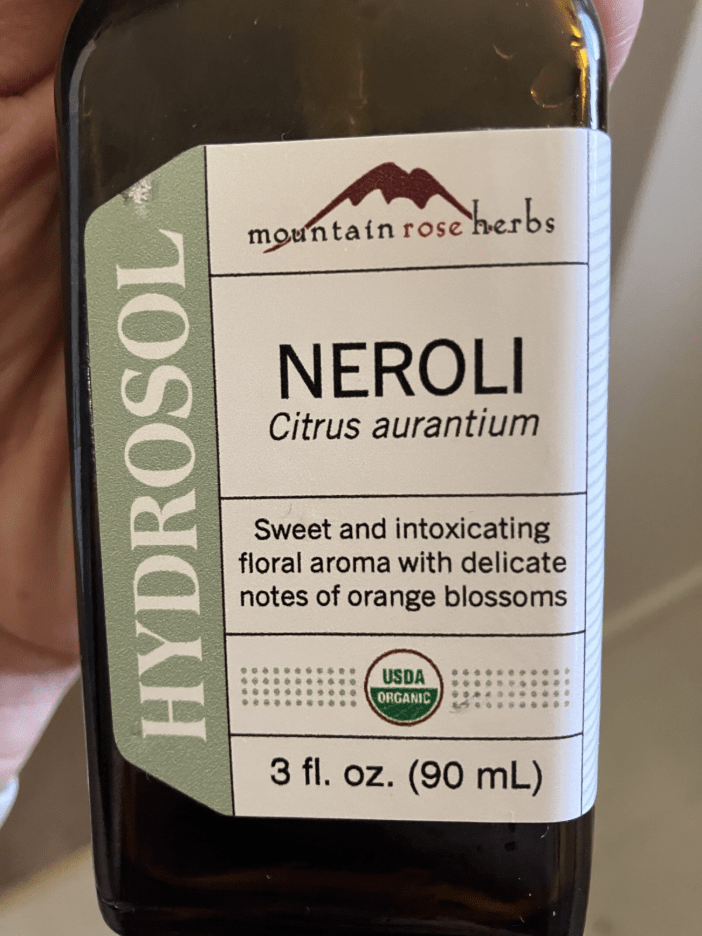
Traditionally made during the process of steam distilling essential oils, hydrosols are purely plant scented water. They are often used to make bath, body, and facial products because they are less concentrated than their essential oil counterparts. Their scent is notably lighter, but still delightfully present, and since they are less concentrated, they can be applied directly to skin. I use witch hazel as a toner, but I often add either rose, neroli, or rosemary hydrosol to the witch hazel for an extra boost. This combination of witch hazel and (any!) Hydrosol is also fantastic for spraying all over the body, or at least exposed parts, to freshen up when a shower is not possible. I keep a small spray bottle of this combination, mine currently consists of rosemary hydrosol, in my desk at work in case I decide to bike there again one of these days. More often though, I spray my face and arms with just a straight hydrosol, right now it happens to be neroli, about every time I go into my bathroom at home. It is a lovely little refresher, lifting my mood and providing a bit of a sweet scent without the heaviness of perfume. (I dab a perfume on my neck and wrists just twice a day during the summer and use a perfume body oil at night before bed.)
Where to Find Hydrosols
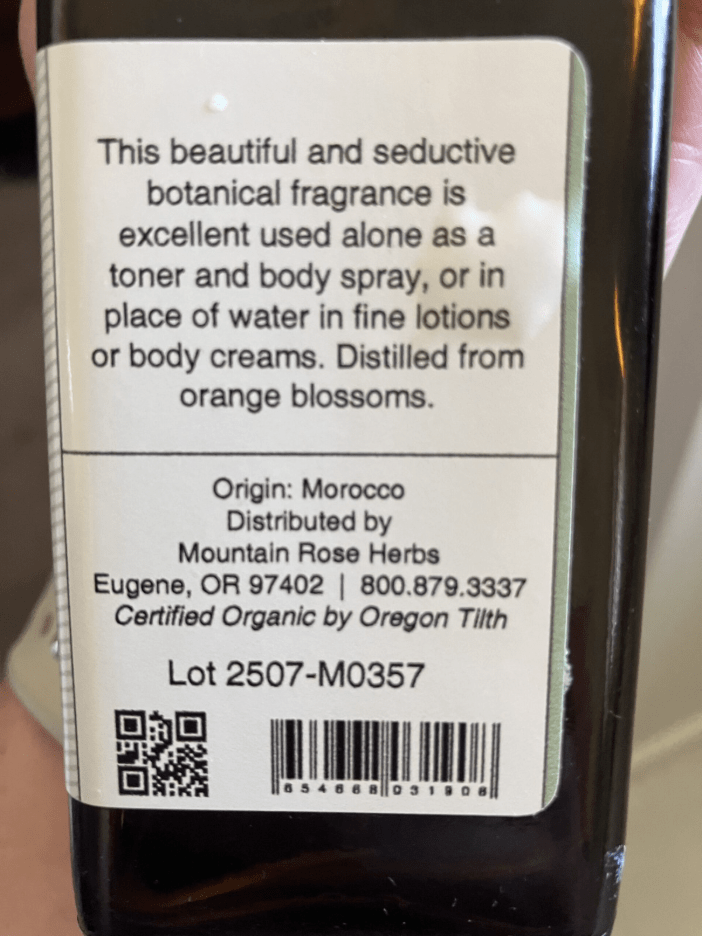
It is a mystery to me why these precious products are hard to find, but alas, they are. Not only that, but there are imposters out there too, so be sure to read the ingredients. Hydrosols are sometimes referred to as floral waters, but floral waters are generally distilled water with essential oils or even fragrance (eek!) added to create the light and bright feel of a true hydrosol.
I get mine from Mountain Rose Herbs, and they are not only authentic, but they are also organic to boot. They happen to have a 25% off site wide sale happening right now, so if you are in need of any herbs or herbal products, including hydrosols and essential oils, now’s a great time to check them out.
The photos show my almost empty bottle of neroli hydrosol, so the label has been warped by use and hydration. I am buying some more this weekend which is what sparked this post.
I just have to share two brands of sauerkraut that are so good that I eat them for taste, not just as food-medicine. Sauerkraut is a fabulous addition to daily diets because it has probiotics, fiber, and is easily digestible. It also happens to be low-calorie, filling, and a fantastic way to get a different variety of vitamins and minerals into your body instead of relying on the ones that are regularly in your routine. Variety matters when it comes to your best health. I started eating sauerkraut with gluten free crackers a few years ago, and back then it was solely to better my digestive health, but now I have really fallen for the taste, especially of the two brands below.
Pangea Garlic Dill Sauerkraut
This one is easily my favorite. I get it in the refrigerated section of my local food co-op, PCC, and it looks like it is in a variety of markets, at least here in Washington. It is made in Bellingham, WA, so the reach might be limited; I am not sure. I hope you can find it though wherever you are because it is so good it will change everything you ever thought you knew about sauerkraut.
Pickled Planet I-Boost Herbal Krauts
This Herbal Kraut is a close second in terms of taste. It was the first sauerkraut I had that I genuinely enjoyed the taste, and not only that, but it also has unique ingredients such as horseradish, nettle, and burdock that boost its health promoting qualities. (Hence its name, I-Boost Herbal Krauts.) I buy this one at Whole Foods and it looks like it can be found in quite a bit of the U.S, plus you can order it online. I do not have it in right now, so I will share the product photo from Pickled Planets’ page:
How to Eat Kraut
Obviously, eat it any way you like! But if you want to get the most health benefits from fermented foods, switch up the ones that you eat, if not daily or weekly, at least buy varied brands each time you restock. You can return to your favorites often, but eating a variety is truly what is best for your gut’s health. Since I was not a sauerkraut fan in the beginning, the only way I could eat it was with crackers. I would put a tablespoon or two of kraut in a bowl and scoop it up with gluten free crackers as a snack. Now, even though I have grown to truly like the taste of sauerkraut, I still enjoy the crunch of a cracker balancing it out.
Fermented Foods
We have so many things working against our digestive systems, especially if we adhere to the modern Western diet, such as ultra-processed foods, glysophate, too much sugar and salt, and much much more. Adding fermented foods can help balance out diets and add health promoting probiotics back into our cores. Choosing a variety to eat is the best way to make the most of what fermented foods offer. Other fermented foods to consider include: kefir, kimchi, kombucha, miso, sourdough bread, tempeh, and yogurt.
What are your favorite fermented foods? I’d love to hear about them! Happy Eating!🥣
*I’m not affiliated with any of the products in this post.
A few posts back I shared some information about pesticides being linked to the uptick in colon cancer among younger people, and how there is a particularly useful ‘dirty dozen‘ list of fruits and vegetables that are the most contaminated. Today I’d like to share more reasons to buy organic foods, and expand the list of foods to always, diligently, buy organic, especially here in America. That reason is: glyphosate, the active ingredient in the herbicide, Roundup.
Where is it used?
Unfortunately, it is ubiquitous all over the world. Countries which use the largest amounts of glyphosate are Brazil, the USA, Japan, Argentina, and China. If you do not see your country in that list, don’t get too comfortable because unless you live in Sri Lanka, Togo, or Vietnam, your country uses it too. There are partial bans in many parts of the world, such as in the EU, but those are only partial restrictions, with some countries having stricter bans than others, even within the EU. The crops it is most widely used on are soybeans, corn, wheat, barley, oats, tree nuts, sugar beets, cotton, and fruits.
Why is it bad?
Glyphosate has been associated with cancer risk, hormone disruption, neurological concerns, acute poisoning (when being sprayed), and physical irritation. It has long been suspected of being the reason so many people now have a problem digesting wheat (gluten), especially in the U.S. This is likely because glyphosate is antimicrobial, meaning that it kills the good microbes in the gut, just like a round of antibiotics kills the good little critters in the gut. Those microbes in our gut are essential to not only our digestive systems, but also form the backbone of our immune systems, and affect our moods and mental/emotional health, and more.
Even Hippocrates has been attributed to the famous line, “All disease begins in the colon,” and whether or not he said that, it’s true that traditional healing systems mostly operated under that principal. This MindbodyGreen article explains the antimicrobial news a bit more, and it is a great read, but I don’t think it goes quite far enough to connect all the dots.
Common Food Allergens (connecting the dots)
When we look at the crops that are most widely sprayed with glyphosate, we see that many of the most common food allergy/intolerance foods can be found on the list. The 9 most common food allergens are: milk, eggs, peanuts, tree nuts, shellfish, fish, wheat, soy, and sesame. Take a closer look, and notice that glyphosate can also contaminate dairy products and eggs because they often share farms with crops that are sprayed. Similarly, glyphosate can contaminate fish and shellfish due to the runoff in waterways, and it can also contaminate peanuts, and sesame seeds due to the soil absorption from the spray on nearby crops or on them directly. That covers the complete list of allergens!
When discussing foods that people tend to have intolerances to, meaning the foods irritate them but there isn’t a full allergic reaction, they are often the same foods as the top allergens, but corn is also a big one on that list, which is widely sprayed with glyphosate.
What to do?
The best way to avoid ingesting glyphosate residue is to buy organic foods, including all bread products, oatmeal, granola, oils, packaged foods, rice, eggs, and, well, just everything you eat. Support organic farmers by joining CSAs, going to farmers’ markets, and making sure everything you buy at grocery stores has at least an organic seal. (Summer is a wonderful time to visit local farms which often host community events.) There is a glyphosate free label that you can look for, but it is not used widely yet:
Full Circle
One thing that the Slow Food Movement emphasizes is that there shouldn’t be a separation between the agricultural industry and the food industry. We think of agricultural ‘crops’ and ‘products’ and governments pass laws and regulations concerning growth and profits. The food industry tends to be thought of in terms of grocery stores and restaurants with regulations around cleanliness and shelf life. The fact that those ‘crops’ and ‘products’ are actually the very same foods that we buy at stores and in restaurants somehow seems to get lost, not to even mention the fact that our health is intricately based, fundamentally, on that same food. We are what we eat, after all. While what we eat, foundationally, comes from farms.
It’s important to note that what is good for us as people is also good for the environment. Clearly spraying toxins on earth is polluting the soil, water, air, as well as the foods we eat. It’s creating food that is less alive and nutritious, and causing disruptions in long time ecosystems.
Other Resources
Another way to protect yourself is to buy a water filter, which is something I still need to research a bit more myself before deciding on which one to buy. In fact, I really need to do a lot more research on glyphosate in general! I just got a book from the library about it, but I wanted to share some info here before I get sucked into my summer quarter schedule since I rarely find time to write when I’m teaching a lot of hours. If you are interested in taking a deep dive into glyphosate (in a safe way!), these articles by EWG are a great place to start. This article also has some really interesting information, and calls out some specific brands/products to avoid. Food Tank is also full of amazing articles and they have a podcast too.
Stay Healthy and Curious🌿and have a Happy Summer☀️
This free docuseries has some great information about traditional healing methods and most of all, herbs. What I like best about this series is that it makes it clear that whatever health issues you might be having, even smallish things that you just have dealt with for years, there are herbs and natural remedies out there to help assist you move back towards better health. I highly recommend checking it out, even if only an episode or two in the series sound interesting to you.
I’m not affiliated in any way, just sharing because I think it can be beneficial for many.
Carlo Petrini, founder of the Slow Food Movement, passed away recently on May 21st. He led the global conversation regarding how to make food good, clean, and fair for all. He was one of the first to recognize that fast food culture was the antithesis of those values, and he worked to educate others of the problems inherent in the glorification of speed and the policies that support it, as well as elevate those that use sustainable and traditional practices. His work lives on in the Slow Foods Movement, Terra Madre, and the University of Gastronomic Sciences, and through all the lives touched by his clear, visionary mind and his heart for sharing his forward-thinking astuteness.
With Bread
In speaking about Carlo Petrini, another Slow Foods and slow living advocate, Carl Honoré, praised him as a wonderful companion in a BBC interview. Honoré explained that the word ‘companion’ comes from the Latin words, com, meaning ‘with’, and panis, meaning bread, and originally referred to breaking bread with someone. Nothing delights me more than a satisfying etymology, and this one is my new favorite!
There’s a reason food is central to our gatherings and celebrations, sharing that moment with others creates a bond that is unlike any other and speaks to something deep within us. We have the choice to slow down with people in our lives every day and resist the culture of speed with its thin values. After all, where do we end up by speeding through life? Most of us are aiming for longevity, not brevity.
Slow Values
Since the Slow Food Movement began, there have been many offshoots, some directly connected to the original movement, such as, slow wine, slow fish, slow food editore, and others that have arisen through inspiration, such as slow living, slow travel, and slow flowers. The word ‘slow’ implies depth, understanding, and authenticity, in a quickening world that relies on superficiality and illusions. The Slow Foods Movement is mourning its founder, but it’s stronger than ever and certainly more necessary. Where do you want more slowness in your life? I hope you find it and better yet, I hope you create it.
Slow walk with my dog
There is no doubt, Carlo Petrini leaves a legacy with the Slow Food Movement that reaches far beyond food.
Recent research has shown a link in pesticides and the rise of early onset colon cancer. This can serve us all as a reminder that pesticides have very real risks and damaging effects on our bodies and our lives. There are significant reasons to eat organic foods, and this seems like a good time to review EWG’s Dirty Dozen list for 2026, as well as their ‘Clean Fifteen’.
EWG
As a reminder, the Environmental Working Group (EWG), which I have shared here before, tests fruits and vegetables each year to gauge how contaminated they are. The list of the most contaminated foods is called the Dirty Dozen and it changes slightly each year. These are the foods to prioritize buying only organic options because they have the most toxic residue on them when grown conventionally. The Clean Fifteen is the list of the produce with the least amount of toxic residue when grown conventionally. The lists on EWG’s website have more information, so I recommend checking that out, but for the TL; DR:
Yesterday morning I was craving something different, but I didn’t feel like going anywhere so I needed to work with what I already had in the kitchen. To be honest, I’ve been having a hard time enjoying the usual foods that I eat after returning from a trip to Europe. The food there is so much better in so many ways, plus I didn’t have to make any of it so I was constantly being gifted the experience of new ingredients put together in ways that I’d never have thought of, and these new concoctions thrilled me, even when they weren’t something I’d particularly want to recreate myself.
Cruise Camp
We were on a Rhine River cruise, and I had never before traveled on a ship. The closest experience that I can relate it to is going away to summer camp as a kid, which I loved but only did a small handful of times. In both instances you meet people from various places, eat and experience new things every day with them, go to bed tired and wake up too early to start the next day full of new experiences with these new friends, then you all go home your separate ways with some photos, memories, and promises to keep in touch.
Instead of nature hikes there are city center walks, and instead of crafts there are optional cheese and wine tastings, but it really made me think about how many fewer opportunities we have as we get older to be thrown together with new people for days on end and delight in our commonalities and discuss our differences and experience unusual things together. It’s special, and unique, and I can understand why people get hooked on cruises even though overall it would not be my choice of travel mode.
Back to Muffins
These vanilla muffins were basically the same as I’ve made before, except this time I didn’t reduce the sugar as much as I used to, and that is what gives these the pound cake effect rather than the other, plainer, version. (Those are also good, just different.) I also changed where I baked them by instead of using the middle rack, I moved the rack up a notch, so they were slightly closer to the top of the oven. Both tweaks made a difference where the complete outside of all the muffins had that pound cake topping encasing them which made these such a treat.
Start by preheating oven to 425 degrees and prep your muffin pan with either paper liners or spray oil. Add the dry ingredients (besides the sugar) together in a bowl and stir. Cream the sugar and softened butter together with a hand mixer. Add the vanilla and mix again. Add the eggs (or egg replacer) and mix, then add the dry ingredients a bit at a time while mixing, rotating with adding the half cup of oat milk. The batter looks like a cake batter. Scoop the batter into a prepared muffin pan for 12 normal sized muffins. Put the pan in the oven and immediately turn the temperature down to 375 degrees. Bake for 30 minutes, then let them cool on a cooling rack for at least five minutes before digging in.
They taste delicious alone but really shine with strawberries, especially with a scoop of vanilla yogurt.
Happy middle of May. I hope you have some sweetness this week.
A few years ago, you couldn’t walk down a functional drink aisle without seeing a plethora of bottles boasting adaptogenic herbs such as ashwagandha or maca. Those products still exist today, but the popular herbal trends have moved toward mushrooms while adaptogens have moved into the background. The next new trend will surely bubble up and over throughout grocery and supplement aisles, but just as it’s important to have a staple wardrobe that can ride the fashion trends through the yearly changes, having a foundational wellness practice will serve you lifelong through ages and stages. Adaptogens are still a fantastic place to start when looking to integrate herbs into health and wellbeing daily practices.
Why start with adaptogens?
Adaptogenic herbs are a classification of herbs that hold specific similarities in their actions and interactions with humans. Adaptogenic herbs have traditionally been viewed as ‘causing no harm’ (*more about this later) because they adapt to what the individual body needs and always move that body toward balance. For example, Tulsi is an herb historically known to regulate blood pressure, which is most often used when people have high blood pressure, but people with low blood pressure can also safely use it without fearing the herb will dip their blood pressure further down. It adapts to what the body needs and balances it without causing further issues. These herbs also help the body adapt to stress, meaning physical, emotional, mental, and environmental stress. Aptly named classification of herbs, am I right?! Balance is the ultimate goal in herbalism.
*Caution
Herbs can interact with pharmaceuticals in unpredictable ways, so if anyone is on any sort of pharmaceutical, they should consult with someone who understands herbs and potential interactions before assuming it is safe. This likely means a naturopath or an herbalist found on the AHG website (in the U.S.), or a registered herbalist or other practitioner in other countries. Also, anyone can have an allergy to any plant material, so keep that in mind as well. The last caution with adaptogenic herbs has to do with the most common one, ashwagandha. It is generally avoided by anyone with thyroid issues, especially hyperthyroidism, because of how it acts through the thyroid. It’s important to note that this is a caution due to looking at how the herb acts, not on reported issues.
Adapting to Stress
We likely all have at least one thing in common; our lives are stressful. Life has always included stress, but modern life is stressful in a multitude of ways, layered upon each other in a competitive sandwich of threats, demands, responsibilities, and anxieties. Adaptogenic herbs can help make this sandwich more palatable by helping the body move from constant fight-or-flight high-cortisol mode to a more relaxed and responsive baseline. Adaptogenic herbs have traditionally been used in the following ways: physically, to improve energy and stamina; mentally, to improve mental processing and learning; emotionally, to regulate moods, reduce anxiety, and lower stress levels.
This all matters at a fundamental level which is hard to overstate. Having a body amped up on stress affects all areas of life, including sleeping and eating, moods and energy levels, immune system function and mental processing, and that’s just the start. All of these dictate our baseline health, how we feel day to day, and how we grow and age over time. When looking at long term health, stress, and inflammation are huge markers that reflect our present and likely future states.
Endocrine System
Adaptogens have wide reaching overall health promoting affects because they work mostly through the endocrine system. The endocrine system is responsible for stress response and management, and our hormone production and movement. Hormones are the body’s messengers responsible for regulating moods, growth, sex, sleep, energy, metabolism, stamina, and more. They move throughout the entire body and are involved in almost every bodily system, making them key players in all aspects of health and healthy functioning. Considering the snowball effects of stress and unbalanced hormones on health, beauty, and aging, it is easy to see why adaptogens have a long history of traditionally being used as longevity herbs that promote overall health, improved immunity, beauty, and well-being.
Five Common Adaptogens:
Ashwagandha (Withania somnifera)
Ayurvedic herb with the name meaning “smell of a horse” because it imparts strength and vitality
Traditionally used for energy, stamina, and coping with stress, as well as for helping with sleep issues
Also used as a restorative after illness or trauma, or for failure to thrive (children)
Used to benefit cognition and focus, lower blood sugar levels, and reduce cortisol
Used for centuries in TCM, Russia, and Scandinavia, and recently has become popular in the U.S. and Canada
In the Soviet Union it was used to support Olympic athletes and cosmonauts because of its reputation for boosting stamina and supporting both mental and physical performance
Rhodiola is often found in blends focused on brain health and performance
In general, adaptogens act slowly and deeply, therefore they are to be taken over a long period of time. It is almost always best to taste herbs, so capsules are the least recommended way to take them, but it’s better to take capsules than none at all. The other reason capsules generally aren’t the best option is because they take a bit of effort through the digestive tract, and knowingly or not, most people do not have optimal digestive systems, therefore, extracts, teas, and powder delivery are generally preferable. Expect to notice changes gradually, 6-8 weeks after the start of adding them to your daily regimen. It’s a good idea to use different adaptogens over time, so starting with one herb or a specific blend for 2-3 months, then moving on to a different one is ideal. They can be found in pill, tea, powdered, and extract form, and it’s always best to follow the directions on the bottles or your natural health practitioner’s guidelines. Personally, my favorite way to take them is to make blends of the powdered herbs and add them to my morning protein smoothies. There are also extracts of blends, such as this adapt care blend, or this bundle of simples in extract form.
Summary
To recap, adaptogens can benefit the following:
Anti-aging
Beauty
Brain function
Energy
Growth
Metabolism
Mood stabilizing
Sleep
Stamina
Stress management
Sex function/desire
Weight management
And More…
Adaptogens affect all these aspects of life, and more, to varying degrees, depending on the specific herb.
Herbs with adaptogenic properties have affinities for certain parts of the body or bodily systems, but all have key actions through the endocrine system.
To be considered an adaptogen, an herb must be at low risk for causing harm, meaning most people can take them without risk of negative side effects. (Always discuss with a health professional, especially if you routinely take pharmaceuticals as herbs and pharmaceuticals can interact in unwanted ways.)